
After Nijinsky: Conan Amok’s “R/evolution(s)” / Teita Iwabuchi’s “The Great Afternoon: the soft machine xxx” Work in Progress Double Bill Review
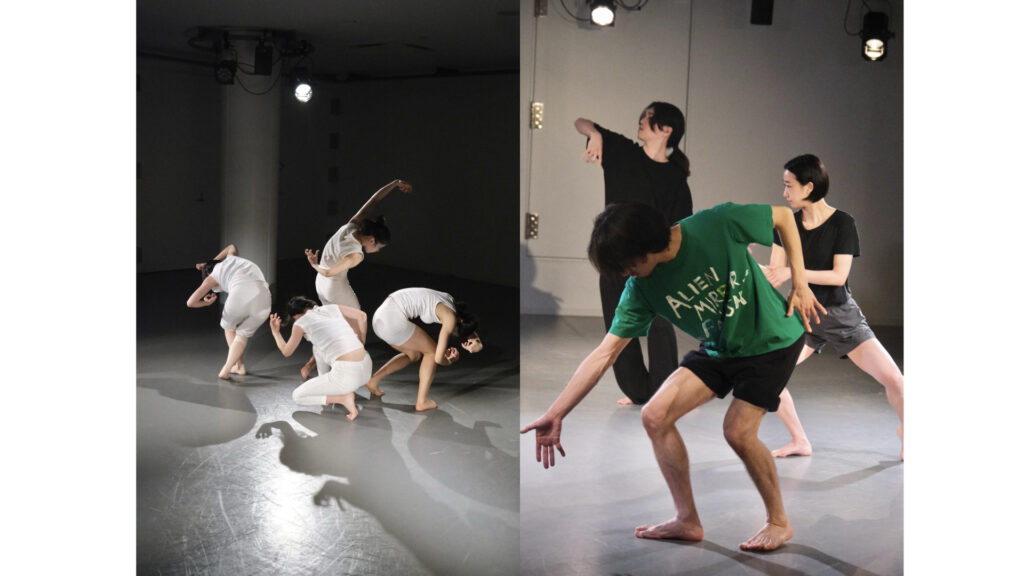
Conan Amok “R/evolution(s)” / Teita Iwabuchi “The Great Afternoon: the soft machine xxx” Work in progress double bill|Dance Base Yokohama
Conan Amok and Teita Iwabuchi showed strong resonance at the Work in Progress double bill on Friday, July 18, 2025. Choreography reminiscent of the ballet “Pastor’s Afternoon” was used in both performances.
The Afternoon of a Magi” is a ballet lus based on Debussy’s (*1) “Prelude to the Afternoon of a Magi,” choreographed for the first time by Václav Nijinsky, and is known as a monumental work that rejected the classical style and ushered in the modern dance style. However, “Pastoral Afternoon” is important here because it confirms that both Amok and Iwabuchi can be placed in one of the genealogies in the history of butoh dance penetrated by Nijinsky. In his most recent essay on Nijinsky, Iwabuchi wrote the following.
I used to attend a workshop of Dairakudakan, a butoh company led by Akaji Maro. There, I learned the “Nijinsky” form, which is based on a pose from “Pastor’s Afternoon”. He also practiced the “Nijinsky” form with Butoh dancer Ko Murobushi, a former member of Dairakudakan.
For butoh dancers, however, Nijinsky’s existence was more than just a choreographic reference in the history of butoh. As Yuma Ochi pointed out in his ” Memorandum on Ko Murobushi and Nijinsky, ” Nijinsky was the source of expression that extended to the marrow of the dance, from Tatsumi Hijikata, the founder of dark butoh, to Murobushi, who studied under him. Nijinsky and butoh shared the essence of madness, the generation of something other than oneself. According to Ochi, Nijinsky was completely on the side of madness (in his later years, Nijinsky was diagnosed with what is now called schizophrenia), whereas butoh had a moment to pause between sanity and madness. In the case of Murofushi, according to Ochi, it was the gestures of convulsions that were explored in order to arrive at this borderland. In the case of Amok and Iwabuchi, I am not sure if it is accurate to use the word “madness” to describe what they were doing, but what I found in common in their dances was the gesture of convulsions to reach the state of de-self.
(*) As an aside, Space Not Blank, another Wings participant, performed ” Dance Work No. 1: Claude Debussy’s Practice ” at DaBY in January 2025.
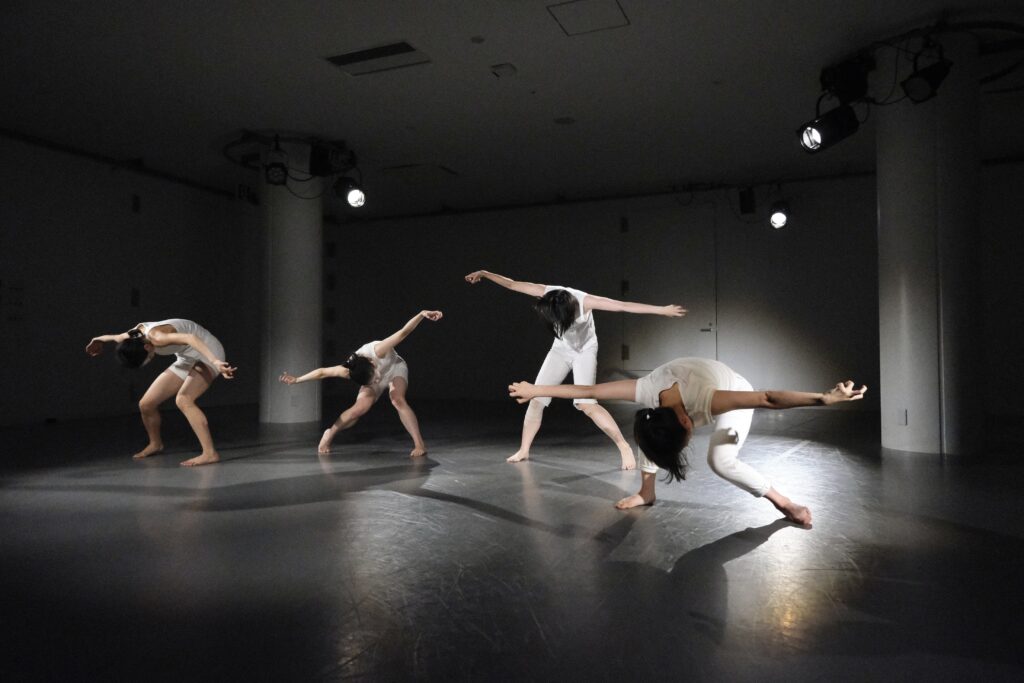 Conan Amok “R/evolution(s)” / Teita Iwabuchi “The Great Afternoon: the soft machine xxx” Work in Progress Double Bill|Conan Amok “R/evolution(s)” Dance Base Yokohama
Conan Amok has been a member of Dairakudakan from 2008 to 2019 and studied under Akaji Maro. This is the second time I have seen “R/evolution(s)” at WIP, and I have already written a review of the first performance. The inorganic and minimalist quality of the work was more pronounced. The performers were dressed in plain white costumes and looked dapper, but their eyes were shaded in black, which was impressive.
The work, entitled “revolution,” has a cyclical structure that repeats specific gestures and sequences. The dancers’ bodies were in the midst of this centripetal structure, which could be compared to the ruthless movement of the celestial body, but there seemed to be a latent moment of deviation from this structure. The center of gravity of the body was kept low, and the expression of the downcast faces was not discernible. The dancers, who continued to spasmodically vibrate the minute parts of their bodies with irregular breathing, looked as if they had metamorphosed into some kind of deformed being that was neither man nor beast. The paradox of letting go of the “I” and thereby escaping from the need to return to wholeness may be the concept that underpins this work. Nevertheless, the work as a whole is dominated by a sharp, stylish, and awakened quality, and the word “revoluion” seems to imply a return to and return from “I” and not being “I” anymore.
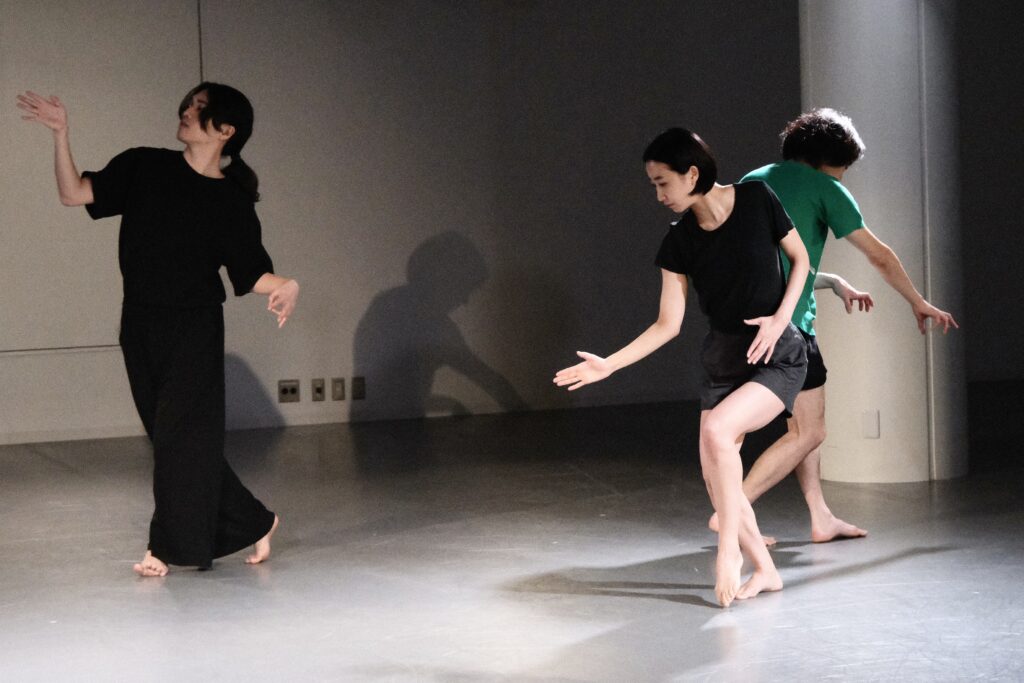
Conan Amok “R/evolution(s)” / Sadata Iwabuchi “Great Afternoon: the soft machine xxx” Work in progress Double bill|Sadata Iwabuchi “Great Afternoon: the soft machine xxx” Dance Base Yokohama
Like Amok, Iwabuchi’s “The Great Afternoon: the soft machine xxx” was also performed once at WIP in March, but this was my first time seeing it. In the first sequence, Debussy’s “Prelude to the Pastoral Afternoon” was played, and the dancers performed a static and flat standing without any leaps or turns. The dancers’ movements are reminiscent of choreographer Nijinsky’s first work.
However, the dancers gradually lose their stability of center of gravity, and a sequence centering on contact movements develops next. I assume that aikido or some similar martial arts style of the body was used as a reference here. In Iwabuchi’s performance, however, stability of the center of gravity, which is usually assumed in aikido, was not an issue, but rather, fulcrums for breaking down postures were found everywhere on the body, and there were exchanges of techniques that made each other look like squishy mollusks. The dancers now lose the center of their bodies. Or, in other words, the whole body becomes the center of the body.
The physicality seen here could be described as a “body without organs. However, I hesitate to do so because the entire performance is dominated by an unusually intellectual calmness, and the above gestures are developed somewhat systematically. In his statement of the work, Iwabuchi proposes the hypothesis that “the body is a soft machine equipped with a rich and precise mechanism that cannot yet be reproduced by modern technology,” and I wonder if this is the kind of physicality that is being referred to here by the term “soft machine”. I wonder if this is the kind of physicality that is being referred to here by the term “soft machine”.
The dancers, who have lost the center of their bodies, soon begin to make strange, inarticulate noises along with convulsive gestures. Kogure Kaho danced this sequence with great charm. While Iwabuchi and Naoyuki Sakai’s voices and gestures could be interpreted rather straightforwardly as representations of a madman, a baby, or a beast, Kogure seemed to be embodying the life and death of an unknown other in a stylish manner, emitting bizarre voices and gestures one after another without stopping at any one thing. Moreover, these gestures were embodied in this body, which was one step away from madness and beastliness, with a temperature that could be called normal fever.
Whether it is Amok or Iwabuchi, their work does not directly follow the stylistic image associated with the word “butoh”. There are probably many people in the audience who do not recognize the so-called “butoh-ness” of the two performers’ works. However, the convulsive gestures of the two dancers in their performances, as if they were trying to reach a state of detachment, and the sane composure they showed in the midst of such a state, suggest that the two dancers, who have been creating works while accepting the thickness of the “post-Nijinsky” history, are making efforts to inherit the essence of the butoh style.
April 23, 2026
Sakuya Uemura
Mentor: Takao Norikoshi (writer and dance critic)
◆Profile
Sakuya Uemura
Critic, born December 22, 1998.
His past writings include “Yukio Shiba: Theory of Theatre Production,” “The Theatre is Under the Hand of the Theatre” (on the website “The Strongest Theory of Theatre-ing”), “The Pitfall of Questions or the Age of Transparency” (on the official website of Space Not Blank), etc. At PARA, he has held “Reading Drucker to Create a Performance and Group” and “The Dramaturg, Today” (on the international magazine “Sound Stage Screen,” English, 2021). Participated in “The Dramaturg, Today” (published in the international magazine Sound Stage Screen, English, 2021) at PARA, and participated in the first phase of DaBY ProLab’s “Dance Critics [Training → Dispatch] Program” by Takao Norikoshi. Participated in “Spring Forward” and was dispatched to Darmstadt (Germany), the host city, for Spring Forward coverage.
Takao Norikoshi
Writer and Yasagure dance critic. Representative of Japan Dance Plug Inc. Currently active as an advisor and juror for theaters, foundations, and festivals in Japan and abroad. He is the author of the book “How to See the Stage in its Entirety: An Illustrated Guide! An Introduction to Contemporary Dance” (Shinshokan), “A Thorough Guide to Contemporary Dance HYPER” (Sakuhinsha), “You don’t watch dance anyway, do you? (NTT Publishing), “Dance Bible” (Kawade Shobo Shinsha), “Dancing All Life: The Story of Saburo Nakagawa” (Shueisha), “Alice: The Story of Fumiko Kawabata, a genius dancer who charmed Broadway” (Kodansha), and many others.
She is currently writing a series of articles in “Buraabo” magazine. She is a mentor for the Dance Critics [Training to Dispatch] Program. She is the leader of the online “Dance Private School.
◆Dance Base Yokohama International Dance Project by Dance Base Yokohama forEmerging Creators“Wings”: International Dance Project by Dance Base Yokohama forEmerging Creators
“Wings”: International Dance Project
by Dance Base Yokohama for Emerging Creators.
The project aims to increase the international presence of Japanese creators, nurture leading Japanese artists, producers, dramaturges and critics, and create opportunities for overseas performances and further revivals of their works.
The project is named “Wings,” and the 12 creators will experience the process of planning, creation, premiere, overseas presentation, and re-staging of their works through a series of training programs including dialogues with mentors and instructors, overseas visits, and presentations at trade fairs. The 12 creators experience the process of planning, creation, first performance, overseas presentation, and re-staging.
In addition to these activities, the project expresses the desire to create an environment in which DaBY can make a leap forward internationally, and to broaden the scope of creators’ activities.
This project is one of the three projects* selected by the Agency for Cultural Affairs under the “Dance Division” of the Creator/Artist Development Program of the Fund for Strengthening the Foundations of Cultural and Artistic Activities (*), with flexible and continuous support over three years based on an activity plan of about five years.
Fund for Strengthening the Foundations of Cultural and Artistic Activities
The Fund for Strengthening the Foundations of Cultural and Artistic Activities has been established at the Japan Arts Council to implement projects for fostering creators and artists and for adding value to cultural facilities through subsidies provided by the Agency for Cultural Affairs in its supplementary budget for fiscal 2023.
The Fund supports the challenge and development of the next generation of creators and artists, and provides flexible, multi-year support for strengthening the functions of cultural facilities that serve as venues for their activities and activities.
*Other recipients are the New National Theatre Foundation and the Japan Performing Arts Foundation (Tokyo Ballet Company).
▶︎ Conan Amok, “R/evolution(s)”
▶︎ Teita Iwabuchi, “The Great Afternoon: the soft machine xxx