Resistance to Verticality: A Review of Conan Amok’s *R/evolution(s)*
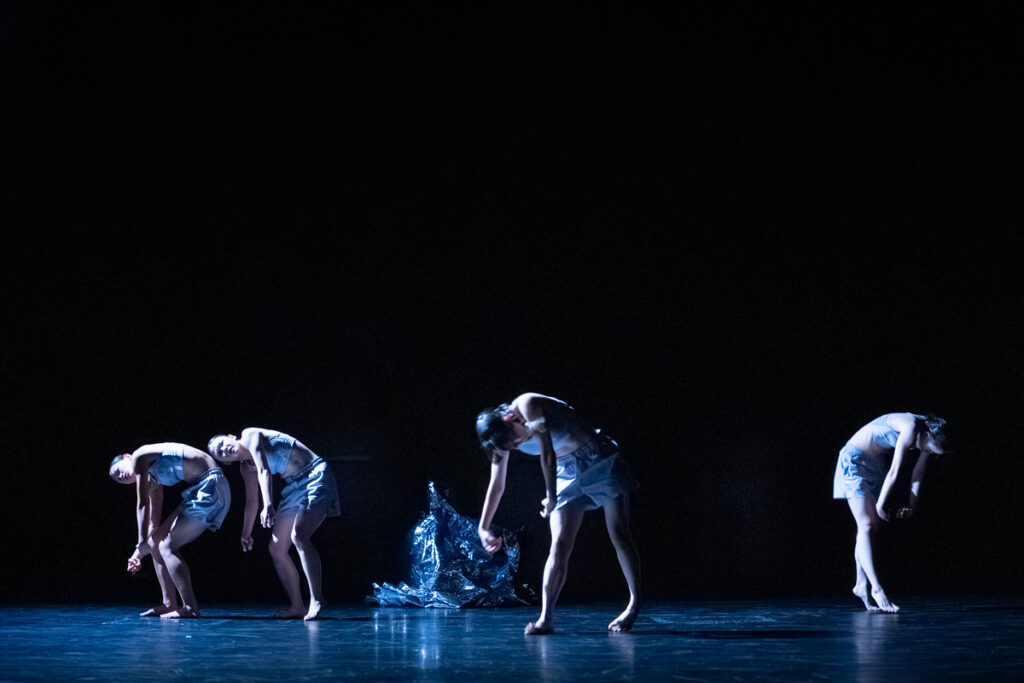 Dance Base Yokohama × Aichi Prefectural Art Theater × Menicon Theater Aoi: Performing Arts Selection 2025 Festival Edition | Conan Amok, “R/evolution(s)” | Aichi Prefectural Art Theater / © Naoshi Hatori
As the performance begins and the dim light gradually breaks through, the figures of four people—their arms hanging limply at their sides and their heads bowed—emerge from the darkness. While a raw beat pulses relentlessly, the four hanging bodies quietly bear the weight of gravity, appearing to accept it with resignation.When viewing Conan Amok’s *R/evolution(s)* as a drama of acceptance, opposition, and resistance to gravity, this posture appears highly symbolic.
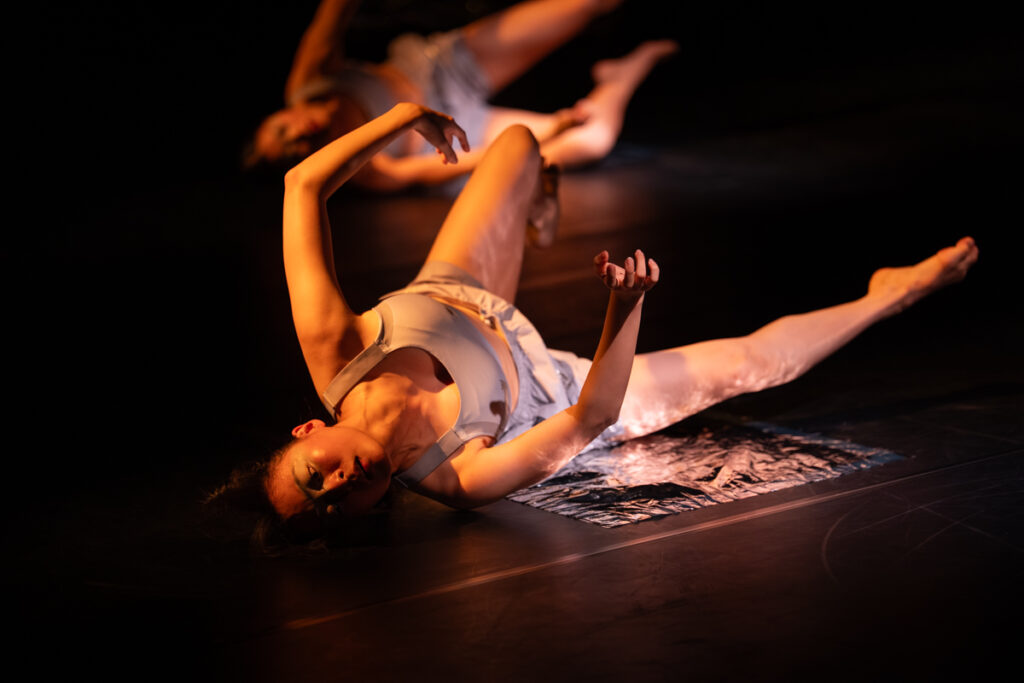
Eventually, the four begin to rise, but after performing a gesture of lifting and then dropping their shoulders—a mimicking of falling—they immediately crouch again, then turn their backs to the audience and sit down stiffly. No, unable even to maintain a stable seated posture, their bodies gradually lie down.In this sequence of movements, the weight of the body, anchored by gravity, is vividly demonstrated.
That said, what I have hitherto referred to as “gravity” might be better understood not as some earthly constraint, but rather as a weight arising from the load of various forces on a celestial scale.This is because the bodies were not rooted in earthly space; rather, that dark stage was bathed in intense primary-colored lighting—green and red—creating a scene reminiscent of a dazzling cosmic expanse.This celestial perspective was already implied in the title itself, “R/evolution(s),” a word derived from “revolution.” The four bodies were each assigned separate positions; while they generally remained in their designated spots without straying,their positions were framed on the floor by square, silver mirror-like panels, and due to the panels’ dull reflection, their bodies—though held low to the ground—appeared to detach from the stage, almost as if they were floating like planets.
 Dance Base Yokohama × Aichi Prefectural Art Theater × Menicon Theater Aoi: Performing Arts Selection 2025 Festival Edition | Conan Amok: “R/evolution(s)” Aichi Prefectural Art Theater / © Naoshi Hatori
Contrary to its name, the Small Hall at the Aichi Prefectural Art Theater, where the performance took place, had a surprisingly high ceiling; precisely because of this, I envisioned the expanse of darkness stretching vertically above the performers and the immense weight of that darkness bearing down upon them.The reflections off the stage mirror and the colorful lighting brought out and emphasized the texture of the bare bodies in various ways, illustrating how the bodies transformed as the dance progressed. At the same time, this emphasis on texture also served to highlight, in a very concrete way, the “tiny”in that vast space in a very matter-of-fact way.
These impressions may have been further intensified by the fact that the work by [Ayaka Ono Akira Nakazawa Spacenotblank], performed simultaneously, featured a low-hanging truss that defined the stage height, effectively framing the viewer’s perspective within a down-to-earth scale.I had seen the “WIP” performances of *R/evolution(s)* twice at Dance Base Yokohama and had written reviews of each, but seeing this performance made me feel as though I was encountering the work for the very first time.In fact, the way the piece manifests itself differs significantly between DaBY—with its white, dance-studio-like interior—and this performance in the small hall. In other words, it was only in the theater that I finally sensed that what the performers are confronting in this piece is the space itself.
 Dance Base Yokohama × Aichi Prefectural Art Theater × Menicon Theater Aoi: Performing Arts Selection 2025 Festival Edition | Conan Amok: “R/evolution(s)” Aichi Prefectural Art Theater / © Naoshi Hatori
Now, the performers’ bodies are not merely held down by gravity.Eventually, those bodies rise up and gradually stretch upward. In this way—as I mentioned at the beginning—the dramaturgy of this work is defined by the interplay between celestial forces and the counterbalance of forces within a single, individual body.
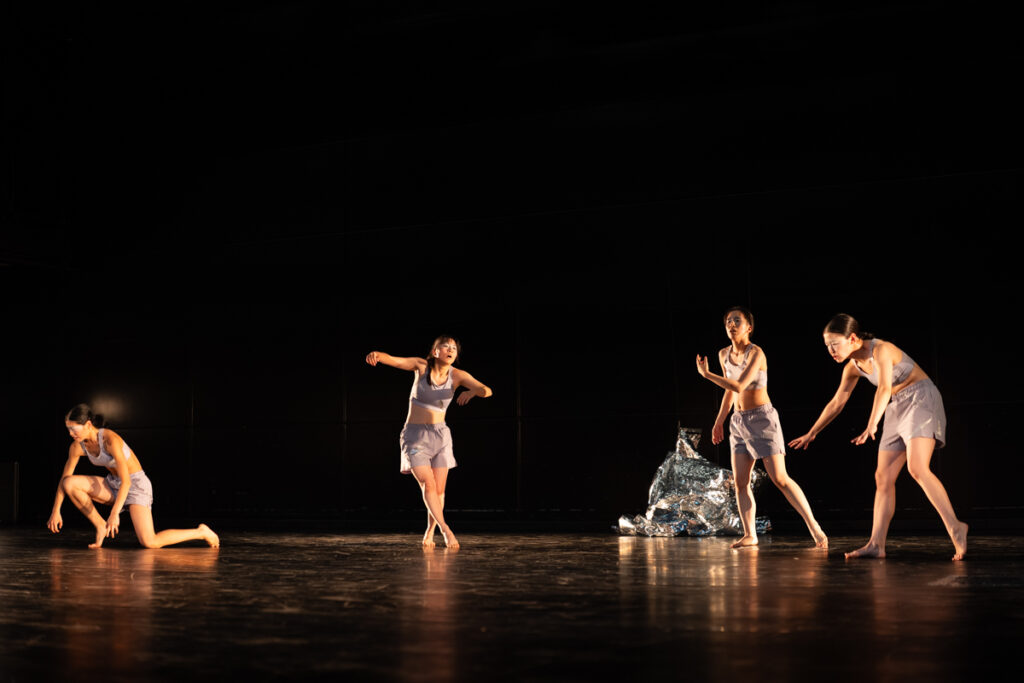
And when this vertical resistance reaches its peak and the performers are nearly upright, the dark stage suddenly brightens. Four bodies on the bright stage. The bodies leave the positions where they had been stationed until then and move about, tentatively testing their voices and gestures. It is almost as if they are enacting the emergence of a new form of life.As the title “R/evolution(s)” suggests, what we have witnessed thus far can be interpreted as a form of “evolution”—the process by which a life form emerges, rises up against external forces, and eventually moves about while exercising self-control. However, darkness soon returns to the stage, accompanied by a fierce beat.The bodies of these life forms convulse, pinned down by an other force, losing their autonomy. Returning once more to the title of the work, the theme that runs through it is likely this: that other external force returns time and again, in different forms, with cold detachment, and each time we cannot help but be swallowed up by its celestial movement.
Incidentally, amid this returning darkness, the mass of silver paper that had been sitting at the center of the back of the stage rises upward, standing tall like a silver pillar.I believe this signifies, in part, the reappearance of verticality on the celestial scale I have discussed at length thus far, but what I wish to mention here is something else.When the mass rose into a column and began to ascend—even though it was likely nothing more than flimsy silver paper being lifted by fishing line, wire, or something similar—I found myself wondering if that silver mass was actually a costume of some sort, and if the person who had been crouching inside it had just stood up.However, I don’t think my anthropomorphic misinterpretation of the silver foil’s upward movement was entirely without reason. The bodies of the four performers were presented in a very matter-of-fact manner, such that they could be regarded as equivalent to the silver mass at the back of the stage.Earlier, I described this work as a microcosm of the evolution of life, but it is entirely possible to perceive here a harsher, more rigid, and more material drama—one set in a space where the distinction between people and objects blurs, and people cease to be people.
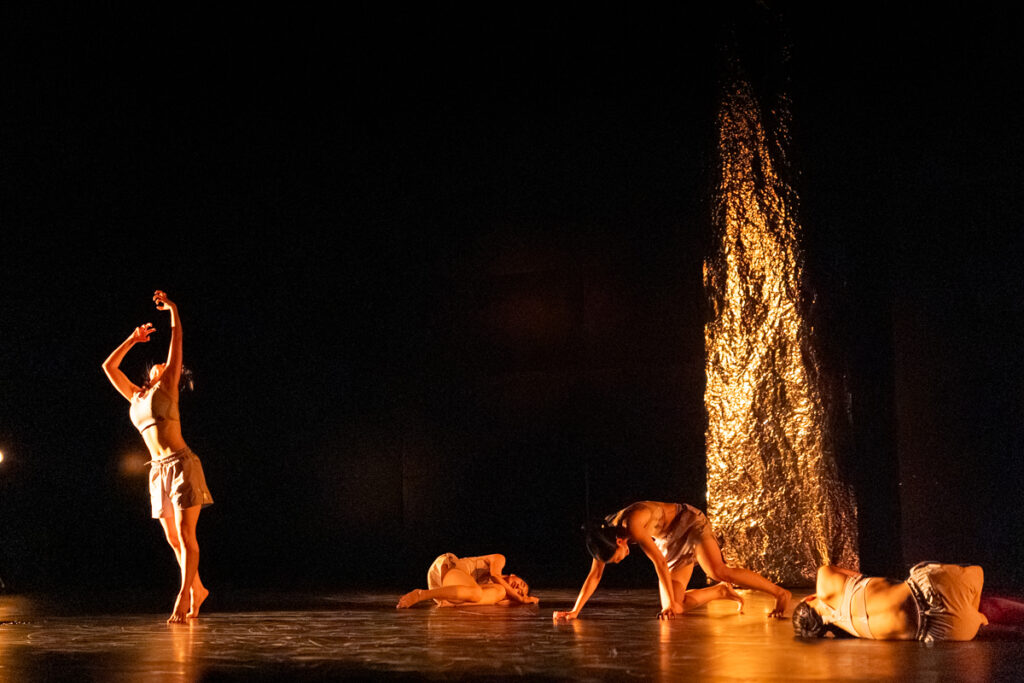 Dance Base Yokohama × Aichi Prefectural Art Theater × Menicon Theater Aoi: Performing Arts Selection 2025 Festival Edition | Conan Amok, “R/evolution(s)” Aichi Prefectural Art Theater / © Naoshi Hatori
Toward the end of the piece, the four bodies—having risen once more in defiance of gravity—step forward and each points with a finger at a specific spot in the audience. It is an eloquent scene in which depth is added to this drama of resistance, which has been performed along a vertical axis, giving rise to a three-dimensional, expansive human space.Indeed, if we superimpose a celestial metaphor onto this drama of resistance against verticality, we can perceive on stage a gravitational force that connects everything in all directions—up, down, left, and right—without distinction. Yet, verticality inevitably returns.The performers’ bodies are once again pressed down lower and lower, and the curtain falls as they assume the same bowed, dejected posture seen at the beginning of the piece. Yet now, their bodies are not merely bearing “weight.” Their arms do not hang limply downward; instead, they are stretched out strongly to the sides, as if seeking to connect with one another.These arms—extending from bodies enduring suffering—are striving to stand upright once more, countering the force that presses down from above. In this way, *R/evolution(s)* illustrates the harsh reality of living in this world, in this body.
June 7, 2026
Sakuya Uemura
Mentor: Takao Norikoshi (Writer and Dance Critic)
Review of “R/evolution(s)” Work-in-Progress (Sakuya Uemura)
1. The Orbiting Swarm—Review of Conan Amok’s “R/evolution(s)” Work-in-Progress
2. Post-Nijinsky—On the Inheritance of the Essence of Butoh: A Review of the Double Bill Featuring Conan Amok’s “R/evolution(s)” and Teita Iwabuchi’s “The Great Afternoon: the soft machine xxx” (Works in Progress)
◆Profile
Sakuya Uemura
Critic, born December 22, 1998.
His past writings include “Yukio Shiba: Theory of Theatre Production,” “The Theatre is Under the Hand of the Theatre,” “The Pitfall of Questioning or the Age of Transparency,” etc. At PARA, he has taught “Reading Drucker: Creating Performances and Collectives” and “The Dramaturg, Today” (The Dramaturg, Today, published in the international magazine Sound Stage Screen, English, 2021). Participated in “The Dramaturg, Today” (published in the international magazine Sound Stage Screen, English, 2021) at PARA, and participated in the first phase of DaBY ProLab’s “Dance Critics [Training → Dispatch] Program” by Takao Norikoshi. Participated in “Spring Forward” and was dispatched to Darmstadt (Germany), the host city, for Spring Forward coverage.
look of triumph
Writer and Yasagure dance critic. Representative of Japan Dance Plug Inc. Currently active as an advisor and juror for theaters, foundations, and festivals in Japan and abroad. He is the author of the book “How to See the Stage in its Entirety: An Illustrated Guide! An Introduction to Contemporary Dance” (Shinshokan), “A Thorough Guide to Contemporary Dance HYPER” (Sakuhinsha), “You don’t watch dance anyway, do you? (NTT Publishing), “Dance Bible” (Kawade Shobo Shinsha), “Dancing All Life: The Story of Saburo Nakagawa” (Shueisha), “Alice: The Story of Fumiko Kawabata, a genius dancer who charmed Broadway” (Kodansha), and many others.
She is currently writing a series of articles in “Buraabo” magazine. She is a mentor for the Dance Critics [Training to Dispatch] Program. She is the leader of the online “Dance Private School.
◆Dance Base Yokohama International Dance Project “Wings” for Next-Generation Creators Taking Flight into the World
Dance Base Yokohama (DaBY) has launched a new project titled “Dance Base Yokohama International Dance Project ‘Wings’ for Next-Generation Creators Taking Flight into the World.”
This project is one of the initiatives selected under the [Dance Division] of the Agency for Cultural Affairs’ Fund for Strengthening the Infrastructure of Cultural and Artistic Activities, which supports the development of creators,Artists, etc. under the Agency for Cultural Affairs’ Fund for Strengthening the Infrastructure of Cultural and Artistic Activities. It aims to enhance the international presence of Japanese creators by fostering artists, producers, dramaturgs, and critics who represent Japan, staging their works overseas, and creating opportunities for further restagings.
▶︎ Conan Amok “R/evolution(s)”