
[Wings] “R/evolution(s)” Body Research Report (Conan Amok)
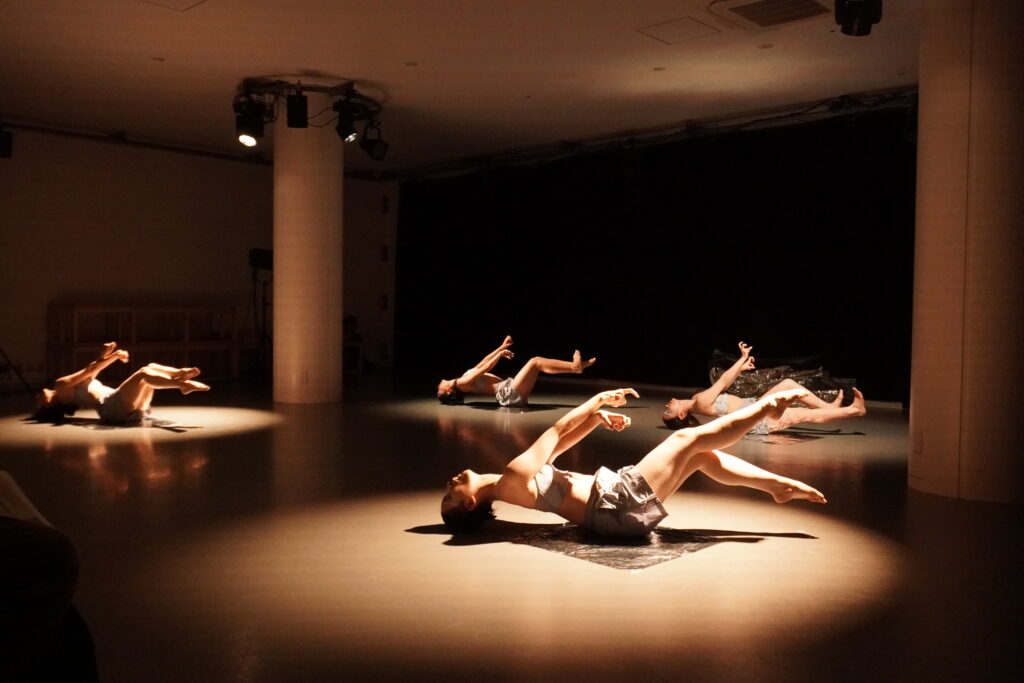 Conan Amok, “R/evolution(s)” Technical Rehearsal Before Departure for Edinburgh | Dance Base Yokohama
1. Introduction: Body Research as a Laboratory for Creation
From June to July 2026, Conan Amok conducted a series of seven body research sessions for *R/evolution(s) * at Dance Base Yokohama ( DaBY ), with a view toward a performance at the Edinburgh Festival.With Yokohama serving as the hub, this research unfolded as an international collaborative practice, connecting Tokyo, Osaka, Vancouver, and Taiwan online, with the participating dancers (Moeka Nagata, Kaya Tsurumi, Mano Hatanaka, and Yuki Matsukura) and the production team ( Dance Base Yokohama ) working together.
The purpose of this research is not a “rehearsal of form” aimed at recreating or preserving a work that has already had its world premiere. Rather, it is an attempt to fundamentally renew the work by deliberately deconstructing its established physical structure and returning it to a malleable state of generation ( In-Formation ).
The theoretical foundation for this is Ame’s theory of the body, “Multi-Layered Body ( MLB ),” and the practical methodology for dynamically testing and developing this theory through bodily practice is the “ Fold Interference Method ( FI ).”
2. Multi-Layered Body — The Body as Ontology
The Multi-Layered Body ( MLB ) is an ontological and somatological framework for understanding the body as a form of existence. In the MLB, the body is neither a single anatomical entity nor a “medium” for expressing inner feelings.Rather, the body is a “space” of fluid and temporary organization where a diverse array of layers intersect in a multi-layered manner, as described below.
Anatomical and Physiological Layers (Skeletal System, Nervous System, Respiratory System)
Perceptual/Sensory Layer (Tension, Friction, Torque)
Time and Memory Layer (Past Dynamic Habits, History, Lingering Time)
Environmental and Spatial Layers (Gravity, Atmosphere, Architecture, and Physical Distance Mediated by the Internet)
Relational and Social Layer (Sense of Distance from Others, Gaze, Linguistic Responses)
The body is not a static, finished form. It is redefined as a ceaseless generative process in which various layers interact with one another, constantly reconfiguring a different “organization” (a temporary arrangement or order of the body) each time.
3. Fold Interference Method — The Kinematics of Generation and the Concept of Force
The Fold Interference Method (FI) is a specific practical research method for verifying MLB theory through physical movement.
① Design of Interference
FI does not aim to achieve a transformed “resulting physical state.” Instead, it focuses on researching the “conditions of the generative process”—that is, the processes through which the body reorganizes itself when intentional interference, such as that described below, is applied to the various conditions that constitute the body.
Compression / Division
Friction / Delay
Resonance / Collapse (Disintegration)
② The Strict Distinction Between “Power” and “Force”
At the core of FI lies the conceptual distinction between “Power” and “Force.”
Power
Definition and Quality of Movement: An autonomous, spontaneous force generated from within through muscle contraction
Body Position: The “agent” that initiates movement
Force
Definition and Nature of Movement: Forces originating from the external world (gravity, magnetism, space, or objectified images)
Positioning of the Body: A “Passage” through which forces pass and linger without distortion
Rather than acting out of spontaneous will, the dancer releases excess tension in the body and prepares the physical and sensory conditions necessary for a “Force”—one that permeates both the external and internal—to pass through. Through this process, pure physical phenomena—such as pressure, friction, resistance, repulsion, density, vibration, and torque—that transcend spontaneous expression are generated within the body.Then, using “Force” as a starting point, they become partially aware of the generation of “Power.”
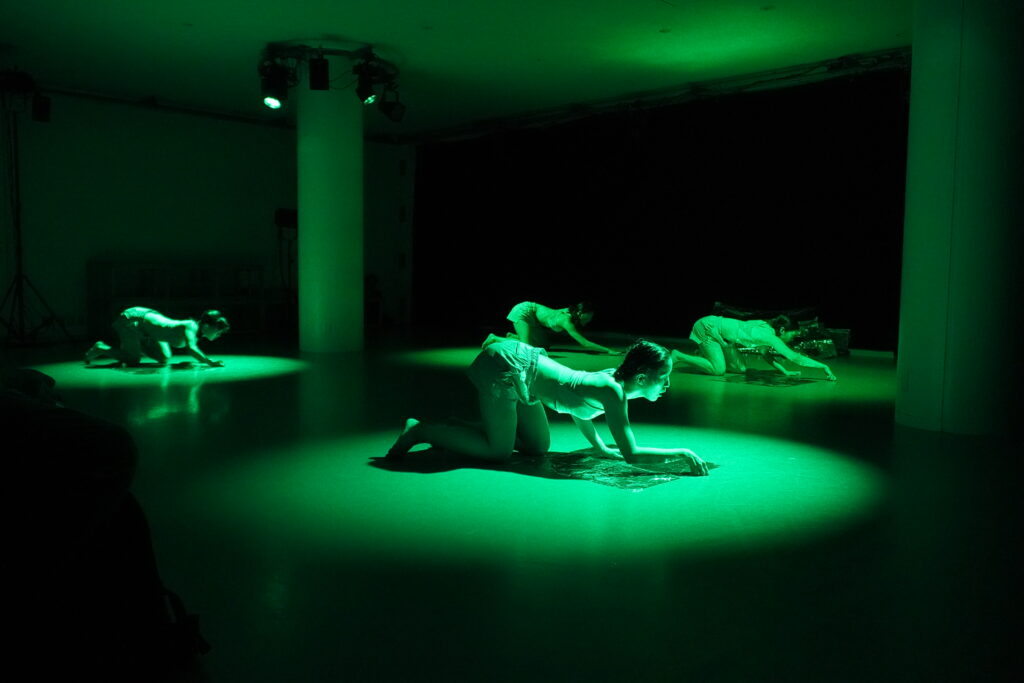
Conan Amok, “R/evolution(s)” Technical Rehearsal Before Departure for Edinburgh | Dance Base Yokohama
4. The Practice Process at Dance Base Yokohama
Over the course of seven research sessions, we used the key motifs of “thread” and “sphere” to examine the various conditions under which the body is generated from multiple perspectives.[Unraveling the Body] → [“Thread” Work] → [“Sphere” Work] → [Verbalization and Dialogue] Relaxation and Force; Nerves, Directionality, Resistance; Gravity, Density, Circulation; Formation of the Creolized Body’s Circuits; Generation of Torque and Friction Phenomena; Interplay Between Interior and Exterior and Wave Motion; Theoretical Renewal of the Method
Step 1: Unraveling the Body — Forming a Circuit for the Passage of Force
Focusing on the awareness of breath and gravity, the body is unraveled into a “medium through which force passes.” Starting from a state that promotes fluidity, the flow was narrowed to create states of density and vacuum, thereby establishing a passive and open condition (Passivity).
Step 2: “Thread” Exercise — Generating Axes, Nerves, and Mechanical Phenomena
Treat the “thread” as a symbol of visible and invisible relationships. After establishing the body’s axis using vertical force, expand the directionality to horizontal, diagonal, and spiral movements.Through repetitive movement, friction, resistance, spasms, and torque (twisting) were generated within the body, causing mechanical phenomena to linger within and pass through the physical form.
Step 3: “Sphere” Exercise — Mutual Penetration with Gravity, Density, and Space
The “sphere” is treated as a symbol of gravity and energy density.Using circular and figure-eight movements to shift “Force,” the body was transformed from subtle vibrations to a total “Collapse.” Through this process, a sensation of constantly moving back and forth between the “interior of the body” and the “external environment”—transcending the boundary of the skin—was refined.
5. Continuity and Discontinuity with Butoh
While the Fold Interference Method draws deeply on and inherits the physical methods of Butoh, it achieves a decisive “separation” and “evolutionary shift” in terms of its focus and philosophical stance.
① From “Bodily Transformation” to “Conditions for Bodily Generation”
Whereas Butoh emphasizes altered states of consciousness and the act of “transformation” itself, FI focuses on the logical and structural process of “under what mechanical and perceptual conditions the body is generated and reorganized.”
② A Reinterpretation of “Relaxation”
FI redefines the concept of “relaxation” in Butoh not merely as physical relaxation (Relaxation), but rather as a mechanical “maneuver (Unbinding)” to loosen the body’s structure—both to allow forces intersecting in multiple directions to pass through and to impose constraints.
③ The Exclusion of Concepts and Emotions and Pure Phenomenology
FI excludes “emotions” (such as sadness and passion)—which are often motifs in Butoh—as well as symbolic, capitalized concepts such as “love” and “death.”It perceives all events occurring in the body solely as “phenomena (pressure, density, vibration, etc.)” that exist prior to emotion. Through this pure phenomenological approach, it clearly distinguishes itself from the view of Butoh that tends to be mystified as the “Dance of Death,” thereby establishing a highly reproducible, kinematic research foundation.
6. Constructing the “Mixed Body” Through Verbalization and Dialogue
One of the most distinctive features of this research is that we devoted as much time to “verbal dialogue and reflection” as we did to practical training.
Dancers from diverse backgrounds other than Butoh—including ballet, contemporary dance, and African dance—verbalized the microscopic phenomena occurring within their own bodies and engaged in repeated dialogue. Through this “mutual translation between words and the body,” a “Mixed Body” emerged where distinct bodily contexts intersected.
Furthermore, going beyond the realm of solo choreography, the Fold Interference Method functioned as a “dynamic method” that was constantly rewritten and continued to evolve through real-time feedback from critical dialogues with the performing dancers and even the DaBY production staff (Yuka Kamimura).
7. Conclusion: A performance is a research process, and a research process is a performance
The series of body research projects conducted at Dance Base Yokohama is an open-ended, emergent process that continually tests the “Multi-Layered Body” (theory) through the “Fold Interference Method” (practice), thereby constantly rewriting the framework itself.
The concepts of “orbital motion” and “revolution” in *R/evolution(s)* refer to the “principle of movement itself”—exposing oneself to an external Force without succumbing to expression, causing the existing self-body (Organization) to Collapse (break down) once, and then reorganizing a new body anew through interference with others and the environment.
This research presents the following firm ontological conviction:
A performance is the “launching of the research process itself,” taking place in the present continuous tense, and the research process itself is the “performance to be shared with the audience.”
The body is not a finished, static entity. It is a multilayered, open prototyping space for the future, constantly being generated through the interference of Force.
August 10, 2026
Ameko Nan 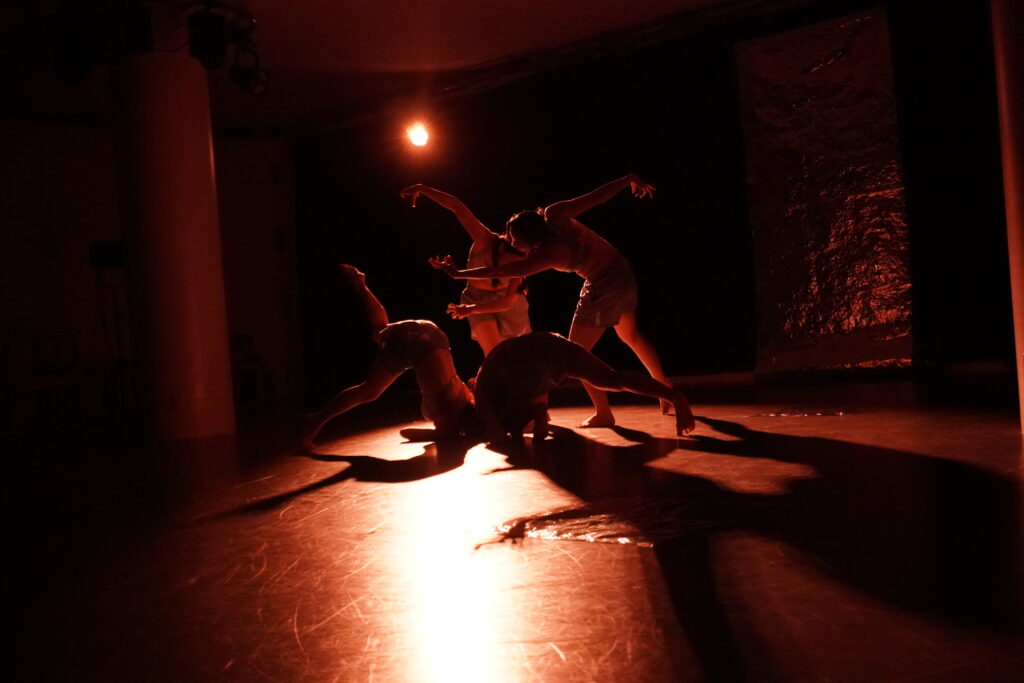
Ameko Nan’s “R/evolution(s)” Technical Rehearsal Before Departing for Edinburgh | Dance Base Yokohama
◆Profile
Conan Amok
Choreographer and dancer. Director of Sanzen CAMP. Graduated from the Department of Sculpture at Musashino Art University (2010). Member of the Dairakudakan theater company; studied under Maro Akaji (2008–2019) Artistic Director of A5yl/Sanzen Kōmō (2022–2024). Her concept is “The Drama of Materiality—Depiction of Texture in Consciousness and Power / Generation of Time and Space through Transformation and Contrast.” Creates dance works characterized by a solid and meticulous physicality, blending a meta-perspective with fervor. Possesses intense technical skill and philosophical depth, researching and practicing the Butoh technique “Multi-layered Body,” grounded in phenomenology and a sculptural perspective. Conducts workshops and performances both domestically and internationally. Has also appeared in numerous stage productions, dramas, films, music videos, and commercials. Awards include the Dance Category at the BAFTA-accredited Film Festival (2019) and the Runner-up Grand Prix at the International Gombrowicz Festival (2022). She serves as an instructor at Butoh Lab Camp, Musashino Art University, and other institutions.
◆Dance Base Yokohama International Dance Project “Wings” for Next-Generation Creators Taking Flight into the World
Dance Base Yokohama (DaBY) has launched a new project titled “Dance Base Yokohama International Dance Project ‘Wings’ for Next-Generation Creators Taking Flight into the World.”
This project is one of the initiatives selected under the [Dance Division] of the Agency for Cultural Affairs’ Fund for Strengthening the Infrastructure of Cultural and Artistic Activities, which supports the development of creators,Artists, etc. under the Agency for Cultural Affairs’ Fund for Strengthening the Infrastructure of Cultural and Artistic Activities. It aims to enhance the international presence of Japanese creators by fostering artists, producers, dramaturgs, and critics who represent Japan, staging their works overseas, and creating opportunities for further restagings.
▶︎ Conan Amok “R/evolution(s)”